

A veteran Unreal Engine developer and evangelist has left Epic Games after 12 years, saying he has to adapt to changes in the industry.
Sjoerd De Jong started his career at the age of 15, when he started making levels for the original Unreal back in 1999. He went on to make a name for himself among the Unreal community for his numerous maps and Unreal Tournament mods, eventually leading to contract work at Epic Games.
In the 27 years since he started working on Unreal maps, De Jong has worked at a number of studios, including Guerrilla Games and Starbreeze, as well as founding his own studio Teotl Studios (The Solus Project, Unmechanical).
In 2014, De Jong then joined Epic Games as a ‘lead evangelist’, whose job was to visit studios, conferences and educational institutes to introduce Unreal Engine 4 to developers and establish it as a leading game development engine.
De Jong then became Epic’s senior director of developer experience between 2020 and 2025, before taking on a senior director of product role earlier this year for “a new and unannounced project”.
In a post on LinkedIn, however, De Jong has now announced that he left Epic Games last week, suggesting that “this era has come to a close” and that he had to “come to terms” with the fact that his way of working is being replaced.
“After 27 years of Unreal Engine, and 12 years at Epic Games and Unreal Engine I have decided to move on,” De Jong wrote. “Last week was my last week at Epic.
“This has been an awesome ride that has been truly life changing in so many ways. I didn’t have an easy childhood or youth and things weren’t going anywhere, but all of that changed entirely when I discovered Unreal Engine. Unreal Engine 1/2/3 put me on a very interesting trajectory for life, which in turn had a profound impact on myself as a person, my personal growth, and opportunities that opened up.
“And then Unreal Engine 4 and 5 did it all over again. Having gone through the whole of the Unreal Engine 4 era, and then the Unreal Engine 5 era while at Epic it gave me a tremendously wide and deep view across the industry and the world. Dozens of countries visited, hundreds of studios visited, hundreds of talks presented, tens of thousands of people met, and millions of developers supported every year.
“I have seen so much over the years, but what will stick with me the most is the community and everyone out there making cool things, and all the energy and passion that comes with doing so. That is what it is all about at the end of the day, to create, have fun doing it, and to help each other.
“But all of that being said, I feel like this era has come to a close, and it is time to move forward. The industry is in a very interesting place. The games industry has always been an industry where change is relentless and inevitable, but it feels like we are reaching a pivotal point now and a potent mix of things.
“As much as I love the old way of working, I think it would be strategic to come to terms with where this is heading, and to work out how to adapt and excel at solving the challenges and opportunities that we face. Let’s see where we end up.”
Although he didn’t explicitly state exactly what he was referring to, De Jong’s departure came in the same week Epic Games started talking about the upcoming Unreal Engine 6 and its heavy focus on integration with AI models like Claude and Gemini.
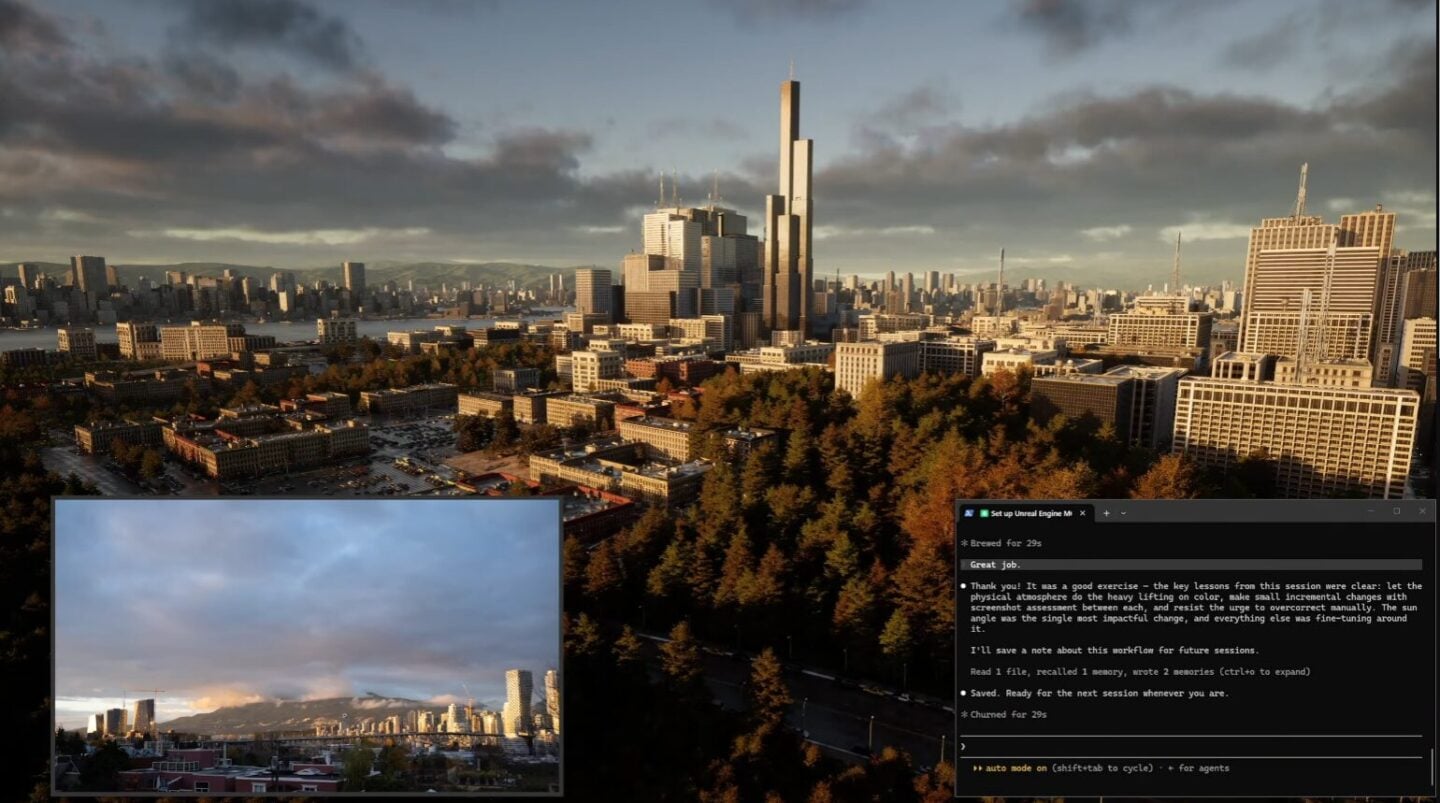
Last week at a State of Unreal event in Chicago, Epic showed how AI large language models (LLMs) can be used directly with Unreal Engine 6 to generate content. During a demonstration, it used a Claude prompt window to furnish a virtual apartment by asking for items, which were then pulled from the assets library.
It later showed how it could change the lighting in a city scene by asking Claude to alter the time of day, or even use a static photo as a reference. Epic stressed that developers will have final control over their creations and can manually change their results.
According to Epic, UE6 will introduce integrations with AI models such as Claude, Gemini, and others, which will act as “creativity and productivity multipliers,” enabling teams to “focus their efforts on the essential creative and technical tasks of development rather than time on time-consuming manual tasks”.
During State of Unreal, the Fortnite maker provided examples of such tasks developers may wish to use AI to speed up, including “setup of levels, character rigs, particle systems, skinning bone weights, as well as adjusting lighting”.


